
Quality of Earnings — What It Is and Why It Determines Your Deal
- Jerry Justice
- Jul 6
- 7 min read

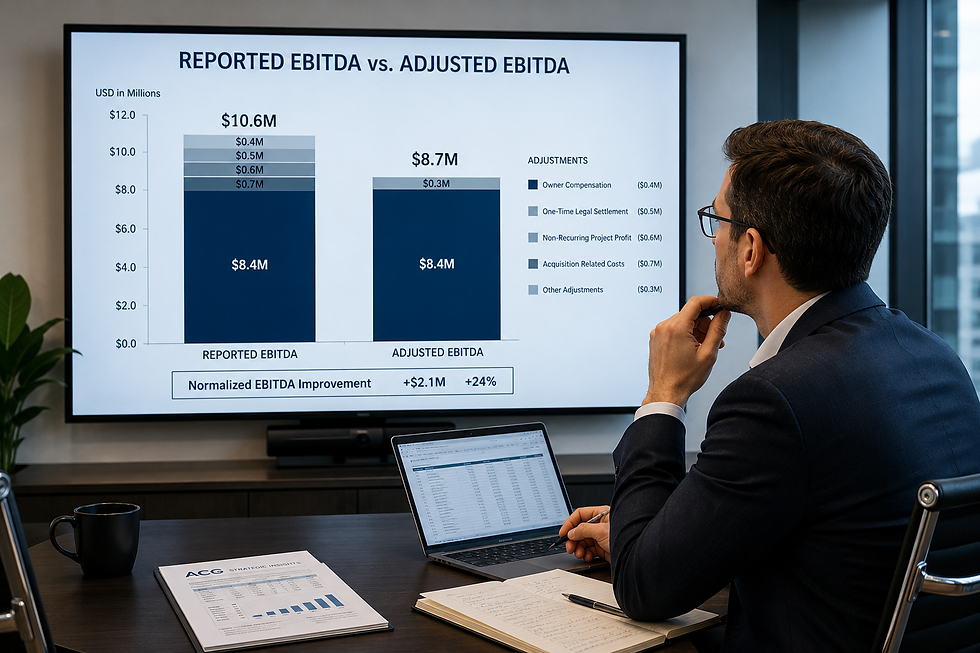
Most mid-market executives can tell you what EBITDA is. Fewer can tell you why it didn't hold up through diligence — and why they left millions on the table because of it.
That gap is where quality of earnings lives.
It isn't an accounting technicality. It isn't a buyer's negotiating tactic, though it often functions like one. Quality of earnings — the discipline of separating recurring, sustainable income from one-time events, aggressive accounting, and revenue that won't survive under new ownership — is the financial lens through which every serious buyer evaluates what they're actually purchasing. And in a market as active and unforgiving as this one, sellers who don't understand it before they go to market are playing a losing hand.
What Quality of Earnings Actually Measures
Your income statement tells a story. The question a quality of earnings analysis asks is whether that story will still be true next year — under new ownership, without the conditions that made the last three years look the way they did.
A standard annual audit doesn't answer that. It confirms that your financial statements conform to generally accepted accounting principles — accurate, compliant, and backward-looking. It tells a buyer what happened. It doesn't tell them what will happen once you're no longer in the building.
FASB's Statement of Financial Accounting Concepts No. 1 establishes that financial reporting should provide information useful to present and potential investors and creditors in making rational investment, credit, and similar decisions. Quality of earnings is the mechanism that translates that objective into transaction reality — testing whether the historical record holds as a forward-looking picture of the business.
An independent QoE analysis examines adjusted EBITDA by stripping out everything that inflates the headline number without reflecting repeatable performance:
Non-recurring revenue — the one-time government contract, the litigation settlement, the accelerated order from a customer who pulled forward demand
Owner-related adjustments — above-market compensation to family members, personal expenses run through the business, discretionary spending that won't recur
Aggressive revenue recognition — sales booked before delivery, subscriptions recognized upfront when they should trail over time
Working capital anomalies — accounts receivable aged past collectability, inventory carried at values a buyer won't credit
Stand-alone costs — infrastructure or administrative support shared with a parent entity that a buyer will replace at market rates
None of these are necessarily signs of fraud. Many are the natural byproduct of how private company owners manage their financials. But in an acquisition, every one of them becomes a negotiating point. The further they surface from the start of a process, the more expensive the conversation.
The math is unambiguous. If a QoE analysis identifies $2 million in non-recurring earnings and the deal is priced at a 6x multiple, that's a $12 million reduction in enterprise value — applied in the final weeks of diligence, when repositioning is nearly impossible.
How PE Buyers Use It
Private equity buyers don't read your financials the way your accountant prepared them. They read them looking for everything that won't survive the ownership transition.
The QoE report is the anchor document in their diligence model. Every valuation assumption — purchase price, debt capacity, return targets — gets built on the adjusted EBITDA the QoE produces. When that number shifts late in a process, everything downstream shifts with it.
Scott Linch, managing partner of Forvis Mazars Capital Advisors and the national sector leader of the firm's private equity practice, estimates that at least 90% of PE-backed deals now include a sell-side QoE. A buyer who skips independent QoE work isn't conducting diligence — they're guessing.
What PE teams examine, specifically:
Earnings concentration — how much of adjusted EBITDA came from a single customer, product line, or market condition
Revenue quality — whether top-line growth reflects pricing power and volume, or conditions that won't repeat
Working capital normalization — what a sustainable baseline actually looks like versus the trailing period
Management dependency — whether the business runs without the owner, or whether key relationships and institutional knowledge walk out with them
Two businesses reporting identical EBITDA can receive dramatically different valuations because the quality of those earnings differs. Buyers price that difference with precision.
The Diligence Trap
The most dangerous phase of any transaction falls in the weeks between a signed letter of intent and final closing. Once an exclusive negotiating window opens, the seller loses significant market leverage. The buyer deploys specialized teams to find every justification for a price adjustment.
I've watched companies enter sale processes with complete confidence in their numbers, only to spend the final weeks of diligence defending earnings adjustments they hadn't anticipated. The issue is almost never fraud. It's preparation.
When a buyer discovers an unexpected discrepancy at this stage, trust erodes immediately. Even if the issue is minor, its discovery implies management lacks full control. The buyer uses that doubt to renegotiate price, introduce restrictive escrow terms, or demand extended indemnification. Walking away becomes an extraordinarily painful option for a team that has invested months in the process.
The most common gaps aren't exotic:
Revenue recognition — How you record revenue matters as much as how much you've recorded. Buyers reconstruct it on their terms if yours doesn't align with post-close operations.
Customer concentration — A customer representing 25% or more of revenue carries earnings quality risk. That revenue may not be treated as fully recurring in the buyer's model, and holdback provisions or earnout structures tied to key customer retention become likely.
Tax exposure — Sellers who haven't collected sales tax in markets where they have nexus often encounter late-stage surprises that weren't in anyone's original deal model.
Normalized compensation — The gap between what an owner pays themselves and what a market-rate replacement would cost can swing adjusted EBITDA significantly. Frame it before the buyer does.
Discovered late, none of these are fatal. But they become leverage — buyer leverage — at exactly the moment when you want the opposite.
The Sell-Side Shift
The most consequential change in M&A preparation over the last several years isn't legal or structural. It's financial. Sellers who commission their own QoE analysis before entering a process aren't being cautious — they're being strategic.
Data from a GF Data analysis of 360 transactions completed since Q3 2024 shows that sellers using a sell-side QoE achieved TEV/EBITDA multiples of 7.4x on average, compared to 7.0x for those who didn't. That 0.4x gap doesn't sound dramatic until you apply it to a $50 million or $100 million business.
Michael Vaccarella, partner at Wipfli and leader of the firm's Private Equity and Transaction Advisory Services team, puts it plainly: investment banks are telling sellers, "You should get a sell-side QoE so that we don't have any surprises later during buyer diligence." That advice has become table stakes in every serious mid-market process.
A seller-commissioned QoE surfaces adjustments the seller gets to frame, eliminates late-stage surprises, signals credibility to buyers and lenders, and compresses the timeline because the buyer's team is validating rather than discovering. Three to six months before a sale process begins is the right window. Early enough to fix what's fixable. Early enough to frame what isn't.
Why the Market Raises the Stakes Right Now
The current environment makes earnings credibility more consequential than it was two years ago.
The USMCA joint review that began July 1, 2026, is already prompting cross-border businesses to reexamine supply chain structures and revenue assumptions tied to North American trade relationships. GF Data reported that tariff concerns pushed deal volume down by nearly 40% in Q1 2025 compared to the prior quarter, with companies carrying cross-border revenue exposure facing the sharpest valuation scrutiny. The cost of leveraged debt has moved from roughly 6% to closer to 10% in current structures, which means buyers are modeling returns against a higher hurdle and have less tolerance for earnings that don't hold.
Capital remains available for quality businesses. Investment committees are still deploying committed capital. But the diligence bar has risen, and the definition of a quality business now starts with the credibility of the financial story — before it reaches strategy, market position, or growth potential. Companies that present clean, defensible financial information don't just close deals more smoothly. They compete for a different class of buyer.
Making Your Earnings Defensible
Quality of earnings isn't a concept you prepare for at the start of a sale process. It's a standard you build toward over time.
The companies that command premium valuations and close without late-stage deterioration share consistent characteristics. Their financial reporting is clean and internally consistent. Revenue recognition follows GAAP with discipline. Non-recurring items are tracked and documented rather than buried. Working capital management is intentional. Their management team can walk a buyer through financial performance without the owner in the room.
That discipline produces a benefit beyond any single transaction. Organizations that understand the drivers of sustainable earnings make better decisions throughout the business lifecycle — clearer visibility into recurring profitability, earlier identification of inefficiencies, stronger forecasting, and greater confidence from lenders and boards. The QoE standard, internalized as an ongoing discipline rather than a transaction checklist, builds a better-run company.
The QoE isn't just a financial document. It's a signal about how the business is run. If a transaction is in your future — twelve months out, three years out, or still in the planning stage — the question worth asking now isn't whether your EBITDA looks strong. It's whether it can hold up through sixty days of independent analysis by a team whose job is to find the adjustments. That answer is what your deal is actually worth.
When Your Deal Demands More Than a Strong Model
Transactions are rarely clean. The companies that close at the multiples they deserve have usually done the preparation work long before the process begins — not because they anticipated every diligence question, but because they built their financial infrastructure to withstand one. Aspirations Consulting Group works with mid-market and Fortune 1000 executives at precisely these inflection points — where strategic, financial, and operational demands arrive simultaneously and faster than existing leadership can handle alone. If a transaction is on the horizon, a confidential conversation now is worth more than a defensive one later. Reach out at https://www.aspirations-group.com.
Keep the Thinking Going
ACG Strategic Insights is published each weekday and read by more than 10 million current and aspiring executives worldwide — a daily resource for the leaders who are thinking through what's next. Request a complimentary subscription at https://www.aspirations-group.com/subscription.
Thanks for reading!
~ Jerry Justice
Living to Serve, Serving to Lead™


Comments