
The Board Question That Separates Good Governance From Theater

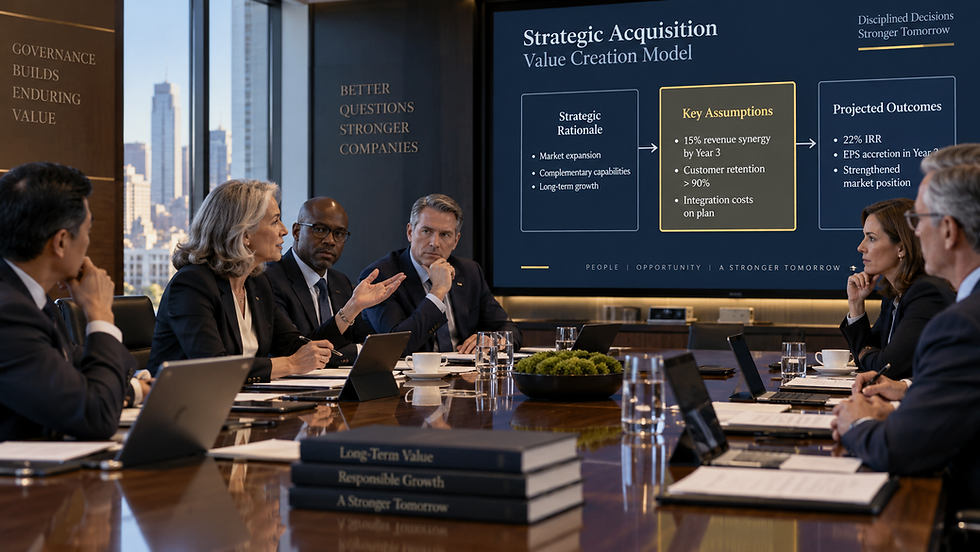
A board meeting can hit every mark on the checklist. The agenda moves on time. Management presents clean slides. Directors nod, ask a handful of polite clarifying questions, and adjourn early enough for everyone to catch a flight home. By every visible measure, the meeting worked.
None of that tells you whether the board actually governed anything.
A second version of that same meeting is also possible. The materials arrive on time. Every question gets a confident answer. The resolutions pass. Directors leave believing they did their job. The two meetings can look identical from outside the room, and only one of them tested a single assumption behind the decision that was just approved.
Last month, I argued that too many boardrooms have built their meetings around comfort instead of scrutiny, and that politeness has quietly become a substitute for oversight. That raised an obvious follow-up. If a smooth meeting is not proof of good governance, what is? What would you actually look for?
There is one question that answers it. Not a framework, not a checklist, not a quarterly self-assessment survey. One question, asked out loud, in the room, on a recurring basis.
The One Question Worth Asking
Before approving a consequential recommendation, every board should ask: "What are we assuming that, if wrong, would materially change this decision?"
It sounds simple. It is not.
Most due-diligence questions test the edges of a decision: customer concentration, financing terms, competitive response, execution risk. Those questions matter, and boards are generally good at asking them. What they often leave untouched is the center: the one or two beliefs the entire recommendation is quietly resting on. Asked seriously, this question shifts the room from reviewing management's recommendation to testing the reasoning beneath it.
A board doing real oversight has an answer ready. Directors can name the assumption, describe how it was tested, and say what evidence would tell them it was wrong. A board performing governance theater cannot answer without reaching for generalities: "we had a healthy exchange of views," or "management was very responsive to our input." Those phrases describe process, not consequence. They tell you the meeting felt collaborative. They tell you nothing about whether the board's presence changed a single decision.
What Good Governance Sounds Like
Good governance sounds specific. It names an assumption, not a mood. It does not need three examples to make its case, because one clear instance of a board testing its own reasoning carries more weight than a dozen references to a productive exchange.
That specificity is what the Organisation for Economic Co-operation and Development has in mind when it describes the board's core responsibility. Its G20/OECD Principles of Corporate Governance 2023 state that boards must be able to exercise "objective and independent judgement." Independence by composition is not the same as independence in behavior. A director can satisfy every formal test of independence while still accepting the frame management hands over and never once testing what sits beneath it.
Sir Adrian Cadbury, whose committee produced the code that shaped modern governance standards worldwide, framed the underlying purpose this way in a 2000 address to the World Bank's Global Corporate Governance Forum, later reprinted in Corporate Governance: Principles, Policies and Practices: "The governance framework is there to encourage the efficient use of resources and equally to require accountability for the stewardship of those resources." Accountability, in that framing, is not a formality. It is the reason the question gets asked at all.
Applying It to Capital Decisions
The question works especially well wherever money is about to move. Ahead of a major capital request, a board can sharpen it further: "If we had to reallocate 20% of this initiative's budget to our highest-margin priority today, what specific trade-off breaks first, and why are we not already making that trade?"
That version forces management out of the comfortable position of confirming that funding exists and into the harder position of defending why this initiative, and not another, deserves the capital. A board that can hold the resulting silence, rather than rushing to fill it, usually learns more in that pause than in the rest of the meeting combined.
What Discomfort Reveals
The most revealing part of this exercise is often not the answer. It is the room's reaction to being asked.
If executives can identify the assumption, explain how it was tested, and describe what would show it failing, the board has learned something valuable about management's decision discipline. If the question produces defensiveness, vague reassurance, or a quick pivot back to the presentation, the board has learned something valuable too. Directors should watch their own reaction with equal care. Does someone challenge an assumption the room had already accepted? Does the chair make room for that challenge, or smooth past it to keep the meeting on schedule?
Mary Parker Follett, writing in The New State more than a century ago, captured the principle every boardroom still needs: "Unity, not uniformity, must be our aim. We attain unity only through variety." A board does not need permanent disagreement. It needs enough independent thinking to know what its agreement is actually worth.
That kind of intellectual honesty is the same idea Mervyn King, who chaired South Africa's King Committee on Corporate Governance, built into the principles-based framework now known as the King Report on Corporate Governance. King's own description of good governance has stayed influential for a reason: "Good corporate governance is about 'intellectual honesty' and not just sticking to rules and regulations." A board can comply with every rule on the books and still avoid the one question that would test whether its judgment is sound.
The National Association of Corporate Directors found real support for this concern in its 2025 director survey. Fifty-four percent of respondents named improving candor among board members as an important or very important priority for the year ahead, as reported in NACD Survey Uncovers 2025 Board Trends and Areas for Improvement, published in Directorship magazine. Directors are not oblivious to the gap between a smooth meeting and a substantive one. Many simply lack a mechanism that forces the gap into the open.
Building the Habit Into the Calendar
A single good answer, once, is not evidence of real oversight. The practice needs structure.
The capital test. Have we approved funding for any initiative over the past 4 quarters primarily because budget was available, rather than because it directly reinforced strategy?
The sunset mechanism. When did this board last formally require the sunsetting or divestiture of an underperforming project or division?
The alignment test. Can every director state the company's primary competitive engine in two sentences, and does current spending reflect that priority?
Answers should not disappear after the meeting. When a board identifies the assumption behind a major decision, that assumption belongs in future oversight: decision, then critical assumption, then an observable indicator, then a scheduled board review. That closes a gap most boards never notice. Performance gets reviewed later, but the original reasoning is forgotten, so when results disappoint, directors can see the variance without knowing which part of the original thesis actually failed.
None of this requires new governance software or a longer meeting. It requires one honest question, asked consistently, and a board willing to hear whatever answer it produces.
The boards that separate themselves from the pack are not the ones with the most polished materials or the smoothest meetings. They are the ones that can point to a specific assumption they tested before it became an outcome. Everything else is theater with good production values.
How ACG Can Help
Growth, leadership transitions, and sustained performance pressure all expose the same weakness: a board or executive team that has stopped testing its own reasoning. Aspirations Consulting Group works alongside boards and senior leaders to build the structures, habits, and candid exchanges that turn oversight from a formality into a genuine advantage, helping organizations move through inflection points with clarity instead of assumption.
Stay Informed
ACG Strategic Insights reaches more than 10 million executives and aspiring leaders around the world each weekday with practical thinking on strategic leadership, financial strategy, technology, business strategy, and executive development. Request a complimentary subscription at aspirations-group.com/subscription and get the next issue directly in your inbox.
Thanks for reading!
~ Jerry Justice
Living to Serve, Serving to Lead™


Comments