
The Candid Feedback Nobody Gives the CEO

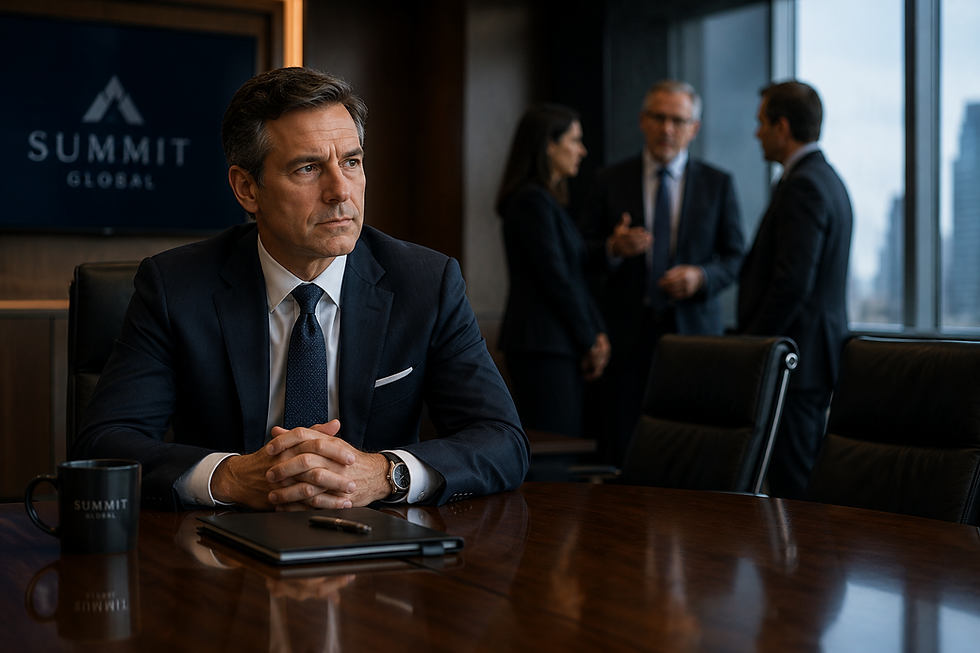
The closer a person moves toward the top of an organization, the less honest feedback they receive.
Not less data. Not fewer reports. Less truth.
There is a particular kind of performance every senior team has mastered — some consciously, some through hard experience. The goal is to deliver information upward in a way that informs without alarming, challenges without threatening, and signals competence without exposing weakness.
By the time that information reaches the CEO, it has passed through several layers of this performance. What lands at the top is not a distortion, exactly. It's a careful editorial — stripped of anything that might trigger a difficult conversation, repositioned to protect the messenger, and shaped around what the CEO has historically rewarded with praise or punished with silence.
Nobody announces this shift. It forms quietly over time. A senior vice president softens a concern before a board meeting. A regional leader removes details that may trigger frustration. A direct report waits another quarter before raising an issue that already threatens retention or execution.
The one person who most needs unfiltered perspective ends up with the most carefully managed version of reality.
Why Candid Feedback Stops Before It Reaches the Top
The first thing to understand is that this isn't primarily a culture problem. It's a power problem.
Every person below the CEO operates with a clear-eyed awareness that their performance evaluations, their compensation, and their access to opportunity all run through — or at minimum, past — the person at the top. That awareness doesn't make people dishonest. It makes them selective. There's a meaningful difference.
Most executives assume people withhold feedback because they fear authority. Fear plays a role. The deeper issue involves pattern recognition. People study leaders constantly. They learn which reactions earn access and which create distance. If disagreement produces visible irritation, difficult conversations become shorter and less frequent. Meetings shift from working sessions into carefully managed performances.
The late Edgar Schein, Professor Emeritus at the MIT Sloan School of Management, spent decades studying how organizations actually communicate — not how they say they communicate. In Humble Inquiry: The Gentle Art of Asking Instead of Telling, he observed that "upward communication is very faulty" in most organizations, noting that subordinates regularly withhold information that would improve performance or prevent harm — not out of malice, but because speaking up across a status boundary carries real social risk.
Chris Argyris documented the same pattern from a different direction. In Overcoming Organizational Defenses, Argyris described what he called "skilled incompetence" — people becoming highly practiced at producing defensive outcomes that protect them from embarrassment or threat, even when candor would serve the organization better. The people around a CEO are not withholding truth because they lack courage. Many are doing precisely what the system has trained them to do.
What Gets Managed on the Way Up
The filtering happens in predictable categories. Executives rarely suppress information entirely. What they do instead is sequence it, frame it, or bundle it — reducing the perceived threat while increasing the chance of being heard rather than shut down.
Bad news arrives late. By the time a significant problem reaches the CEO's desk, it has often been incubating for months while the layers below tried to resolve it themselves. No one wants to bring a problem without a solution. But the effect is that the CEO learns about critical issues at exactly the moment when options are fewest and stakes are highest.
Criticism of strategy gets converted into questions about execution. It's far safer to say "we're having trouble executing on this initiative" than "I think the strategy is wrong." One is a competence problem the team can own. The other is a challenge to a decision the CEO made. The language shift happens almost automatically.
And feedback about the CEO's own behavior — how they run meetings, how they respond to dissent — almost never travels upward at all. Not because people don't have observations. They share them horizontally, quietly, constantly. They share them with executive coaches. They share them with board members they trust. But they don't share them with the CEO.
The Cost of the Managed Version
Research by Donald Sull and Charles Sull at MIT, published through MIT Sloan Management Review, found that toxic corporate culture — the kind that forms when employees believe raising concerns is unsafe — is the single strongest predictor of employee attrition, outpacing compensation by more than a factor of ten. The feedback gap and the culture gap are not separate problems. One produces the other.
Succession plans collapse after years of artificially positive talent reviews. Regional operations hide customer deterioration until recovery requires ten times the original cost. The warning signs almost always exist long before the crisis surfaces. The signals simply die in transit.
And the CEO's own development stalls. No one at the top level is exempt from blind spots or leadership behaviors that have quietly calcified. Without candid feedback, those patterns continue unchecked. The CEO believes they are performing better than they are, not because they're deluded, but because they have no reliable signal to indicate otherwise.
What Doesn't Work
Open-door policies don't work. This bears repeating because they remain the most common response to the feedback gap.
The problem is not access. The problem is perceived safety and perceived consequence. An open-door policy places the entire burden of courage on the subordinate. It asks a vice president to gamble their professional standing on the hope that the chief executive is having a good day. Research by James Detert at the Cornell ILR School and Amy Edmondson at the Harvard Business School summarized in their Harvard Business Review article, “Why Employees Are Afraid to Speak”, found that employees across organizational levels consistently self-censor upward feedback when the perceived personal risk exceeds the expected organizational benefit — and in most hierarchies, that calculation rarely favors speaking up.
Town halls don't work for this purpose either. No one raises a genuinely difficult observation in front of hundreds of colleagues and a CEO who controls their career trajectory.
Even many 360 assessments fail at the top. The standard version — where the CEO nominates their own raters — is a managed process from the start. And even those who do participate know that anonymity in a small senior team is often illusory. A specific observation from a specific context can be traced.
Culture does not form from stated values. It forms from observed consequences.
What Actually Changes the Flow
Structural solutions work where cultural appeals do not. Culture is the output of structures and incentives. It cannot be changed by declaring new values.
Separate the feedback channel from the performance channel. When the same leader who evaluates someone's performance is also the person receiving their feedback, the power imbalance makes candor structurally unlikely. External advisory boards, independent coaches retained for organizational perspective, and structured skip-level conversations with explicit protections can create legitimate separation.
Ask questions that cannot be answered with diplomatic framing. Psychologist Gary Klein's research on the pre-mortem technique, published in Harvard Business Review, demonstrated that asking teams to assume a project has already failed — and explain why — bypasses the social pressure to conform and surfaces concerns people would otherwise suppress. The same principle applies to leadership feedback. Specific, behavior-linked questions are harder to deflect than open invitations. Not "How can I improve as a leader?" but "Describe a recent meeting where you left with a different view than what you'd shared in the room." The framing changes what people allow themselves to say.
Visibly act on the feedback that does arrive. The strongest structural signal that candor is safe is not the invitation to speak — it's the evidence that speaking changes something. When the CEO says, "Based on what I heard, I'm going to stop doing X," and then stops, that observation travels fast. When feedback is solicited and nothing changes, that travels fast too — and closes the channel.
Andy Grove made the observation plainly in Only the Paranoid Survive — the person least likely to know about a change in the environment is the person at the very top. The people who know first are those closest to the customer and the work. Building structured paths for that knowledge to surface — small rotating groups, board-level listening, independent operational audits — is not a luxury. It is how organizations stay honest with themselves.
The CEO's Own Role in the Gap
The feedback gap doesn't exist because the organization is deceptive. It exists because CEOs — often without intending to — create conditions where candor is costly. They do this by reacting visibly when feedback is critical, by rewarding those who bring solutions and penalizing those who surface problems, by running meetings in ways that signal the preferred conclusion before discussion begins.
Liz Wiseman, in Multipliers: How the Best Leaders Make Everyone Smarter, observed that the most effective leaders "ask questions that focus the intelligence of their team on the right problems" rather than signaling the answers they prefer in advance. That principle applies nowhere more directly than to the question of feedback itself.
Leadership maturity is not measured by confidence during easy conversations. It appears most clearly in how a leader responds when hearing something painful or destabilizing. Organizations rarely drift above the emotional ceiling set by the person at the top.
A CEO who wants the unfiltered version has to make the unfiltered version structurally safe and structurally rewarded. That is an operational choice — and it requires consistent behavior over time, not a single declaration.
If every meeting ends with the team aligned and every quarterly review surfaces only manageable concerns, that consistency should be a warning sign, not a confirmation. People always know long before the numbers do.
Thanks for reading!
~ Jerry Justice
Living to Serve, Serving to Lead™
Where Structural Leadership Clarity Begins
The feedback gap is not solved by goodwill — it is solved by design. Aspirations Consulting Group works directly with senior executives and their boards to diagnose the structural conditions that suppress candor and build the leadership systems that replace them. If today's blog describes patterns you recognize in your own organization, the right conversation to have is a confidential one. Start it at https://www.aspirations-group.com.
Keep the Thinking Coming — Subscribe Today
ACG Strategic Insights is published every weekday for more than 10 million current and aspiring executives globally. If you find today's perspective useful, request your complimentary subscription at https://www.aspirations-group.com/subscription and make sure none of them miss you.


Comments