
Trade Secrets vs Patents — The Protection Decision That Changes Your Valuation

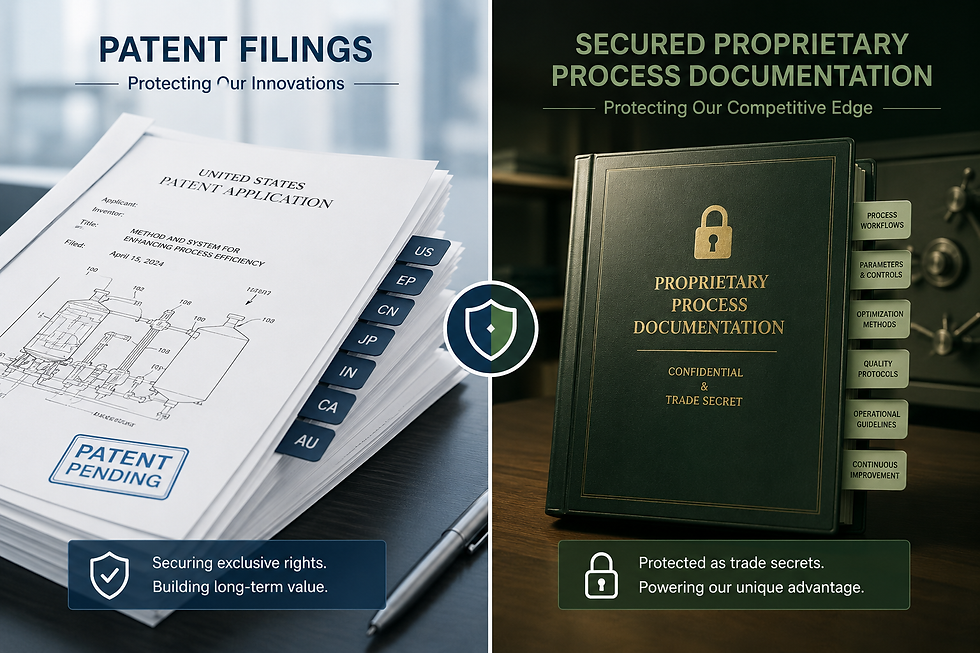
When executives discuss intellectual property protection, the conversation often starts with patents.
In many companies, it also ends there.
That's understandable. Patents are visible. They create an asset that appears tangible on a data room index. Investors understand them. Boards understand them. Acquirers ask about them. Patent counts find their way into investor presentations and annual reports as evidence that leadership has taken innovation seriously.
Yet one of the most expensive mistakes leadership teams make is assuming that every meaningful innovation should be patented — and that everything not patented is somehow protected by default.
Neither assumption is true.
The trade secrets vs patents decision is not primarily a legal question. It's a business strategy question. It shapes valuation, market positioning, operating discipline, and transaction readiness. And it tends to surface at the worst possible moment — in due diligence, when the options for correcting it have largely closed.
Why the Patent-First Mindset Persists
Patents offer an appealing proposition. In exchange for public disclosure of an invention, the owner receives a limited period of exclusive rights. That framework has created extraordinary value for companies across industries ranging from pharmaceuticals to advanced manufacturing.
A patent can signal innovation. It can create barriers to entry. It can strengthen licensing opportunities and provide evidence of proprietary capability when investors evaluate a business.
The challenge is that not all intellectual property fits neatly into a patent strategy.
Many mid-market companies create value through processes, manufacturing techniques, customer intelligence, software algorithms, operational workflows, pricing models, and know-how developed over years of experience. In many cases, the true economic value resides in how something is done rather than what was invented.
Once a patent application becomes public, competitors gain access to information that may help them design around the protected claims. The company receives legal protection, but it also hands competitors a detailed roadmap.
For process-based innovations, the disclosure risk cuts even deeper in two ways that most executive teams don't fully consider. First, if a company has been relying on a manufacturing method or operational process as a trade secret, filing a patent application permanently destroys that protection the moment the application publishes — regardless of whether the patent is granted. If the USPTO rejects the application, the process enters the public domain and the company receives nothing in exchange for what it disclosed. Second, even when a process patent is successfully granted, detecting infringement is genuinely difficult. A competitor can read the published specification and run your process behind closed facility doors without your knowledge. You hold a legally enforceable right, but you may never find out it's being used — particularly by offshore manufacturers who import the unpatented end product.
That tradeoff deserves far more scrutiny than it typically receives.
What Each Protection Actually Does
Patents give you a public, legally enforceable monopoly on a specific invention for a fixed period — twenty years from the filing date for a utility patent. The patent system is built on disclosure as its organizing principle. The moment you file, the clock is running and the specification is becoming public record.
Trade secrets work in the opposite direction. Under the federal Defend Trade Secrets Act (DTSA) — enacted in 2016 and now the primary federal vehicle for trade secret claims — protection exists for as long as the information remains secret and the owner has taken reasonable measures to maintain that secrecy. There is no registration, no public disclosure, and no expiration date built into the structure.
Coca-Cola's formula has been protected as a trade secret since 1886. A patent on the same formula would have expired in 1906. More than a century after its creation, the formula's value persists precisely because secrecy was chosen over disclosure — and that choice has been actively maintained, not passively assumed.
A landmark study by Ivan Png, published in Strategy Science (Vol. 2, No. 3, September 2017), found the Uniform Trade Secrets Act was associated with a 38.6% reduction in patent filings in the year following a state's adoption. That's not a coincidence. It reflects companies making a deliberate calculation — when a credible legal framework for secrecy exists, a meaningful portion of IP is better protected outside the patent system.
Where the Decision Actually Turns
Several factors determine which path is right for any given asset. None of them are automatic.
Reverse engineerability is where the analysis starts. If a competitor can buy your product off the shelf, analyze it, and reproduce your method within a reasonable timeframe, a trade secret provides limited protection — the secret disappears the moment it becomes accessible through legitimate means. For those assets, patents make sense. You've lost the secrecy advantage anyway, so the disclosure trade-off costs you less.
Technology velocity cuts the other way. As James Pooley — former Deputy Director General of the World Intellectual Property Organization and one of the principal architects of the DTSA — observed in his introduction to the WIPO Guide to Trade Secrets and Innovation: "Certain types of innovations are not suitable for patent protection — for example, process technology deployed in private where infringement cannot be detected." Software algorithms, AI model weights, training data methodologies, and proprietary operational workflows fall squarely in that category. Patent examination for complex technology routinely takes two to four years. By the time a patent issues, the underlying method may have been iterated three generations forward. Filing forces disclosure of a version of the technology that may no longer represent your competitive edge.
Patent eligibility has narrowed considerably since the Supreme Court's 2014 decision in Alice Corp. v. CLS Bank International. Subject-matter eligibility for software and business methods has become genuinely uncertain. Companies that spend $15,000 to $20,000 filing and prosecuting a patent application can end up with protection that doesn't survive an inter partes review challenge. Trade secret protection sidesteps that fight entirely.
Exit horizon is a factor that most executive teams underweight. If the long-term plan involves a strategic sale, a well-documented trade secret framework may be precisely what a buyer needs — proprietary systems they can absorb without triggering public disclosure concerns. If the path leads toward a public offering, a visible patent portfolio can serve as a marketing signal to equity investors who rely on traditional valuation metrics. Neither is inherently superior. The mistake is allowing engineering or legal teams to make this call in isolation from the business strategy.
None of this means trade secrets win automatically. They require something patents don't: active, documented, ongoing operational discipline. That's precisely where most companies fall short.
What Buyers Examine in Due Diligence
Here's the part that separates well-prepared companies from the ones that find out they have a problem when it's too late to fix it.
When the DTSA requires that a trade secret owner have "taken reasonable measures to keep such information secret," that standard carries significant weight in a transaction — because sophisticated buyers examine it directly. The diligence team isn't looking for a claim of secrecy. They're looking for evidence of it.
Buyers will ask whether employment agreements explicitly define proprietary processes as confidential, and whether those obligations survive termination. They'll examine whether access to sensitive information is restricted by documented controls — not just passwords, but tiered access governance with audit trails that prove who saw what and when. They'll look at whether vendor and supplier protocols prevent third parties from gaining exposure to protected processes during facility visits or system integrations. And they'll assess whether information is compartmentalized such that no single individual holds the complete picture of a core competitive process.
The courts have made this standard increasingly concrete. In Superb Motors Inc. v. Deo, 776 F. Supp. 3d 21 (E.D.N.Y. 2025), the court dismissed a DTSA claim outright, holding that the plaintiff "far fall short in alleging the existence of a trade secret in that the complaint is devoid of any information that they took reasonable measures to guard such information a secret." Firewalls, usernames, and passwords — without explicit NDAs or formal confidentiality policies — were insufficient. Two additional Eastern District of New York decisions in the same year reached the same conclusion on nearly identical facts: AutoExpo Enterprises Inc. v. Elyahou, No. 2:23-cv-09249 (E.D.N.Y. Sept. 12, 2025), and Negative, Inc. v. McNamara, 2025 U.S.P.Q.2d 448 (E.D.N.Y. March 13, 2025). Three cases. One district. One year. The same governance failure each time.
Most mid-market companies fall into that gap. They have NDAs in place. They may have basic access controls. But they haven't conducted a trade secret audit, haven't tiered their confidential information by sensitivity level, and haven't built the governance structure that holds up to scrutiny. What they have is a trade secret program that exists primarily on paper.
Richard J. Lutton, Jr., former Chief Patent Counsel at Apple Inc., wrote in his foreword to Keeping Secrets: A Practical Introduction to Trade Secret Law and Strategy by Darin Snyder and David Almeling of O'Melveny & Myers: "It's often the detail behind the scenes that makes the difference between the surprisingly successful company and its lackluster competitors."
In a transaction, the detail behind the scenes is exactly what the diligence team is paid to find — or not find.
What This Means for Your Valuation
The Ocean Tomo 2025 Intangible Asset Market Value Study, released in February 2026, found that intangible assets now constitute approximately 92% of S&P 500 market capitalization, up from 17% in 1975. The Brand Finance 2024 Global Intangible Finance Tracker adds a finding that sharpens the governance problem: approximately 79% of total global intangible value remains undisclosed on company balance sheets. That gap isn't primarily a reporting issue. It reflects the difficulty of documenting and demonstrating the value of assets — like trade secrets — whose protection depends entirely on how they've been managed.
When a buyer's diligence team arrives and asks for the NDA inventory, the access log governance, and the trade secret audit records, they're doing exactly this: trying to determine whether the IP value on the seller's model is real or performative. If the company can produce that documentation, the protected IP holds its valuation contribution. If it can't, a discount follows — or the deal stalls while legal teams negotiate representations and warranties around the exposure.
A business that appears to carry $30 million in IP-driven enterprise value can watch that number compress materially when diligence reveals that the core process know-how — the thing the buyer actually wanted — was never formally protected and can't be demonstrated to have been treated as a trade secret. The company assumed the value was there. The buyer's team found a gap no one had been looking at.
That conversation, once it starts, rarely resolves in the seller's favor.
Making the Trade Secrets vs Patents Choice Before Someone Else Makes It for You
The right IP protection strategy for most mid-market companies isn't a binary choice between patents and trade secrets. It's a portfolio approach — deliberate, asset-by-asset, with each decision grounded in the specific characteristics of what's being protected, the competitive environment, and the company's transaction horizon.
Starting with an audit is non-negotiable. Not a high-level asset list, but a genuine classification exercise: what do we own, what's actually driving competitive value, how could each asset be accessed by a competitor, and what protection mechanism fits that risk profile? For some assets, the answer is a patent. For others — and often for the most operationally valuable ones — it's a trade secret program with the governance infrastructure to sustain it.
The companies that get this right aren't just better protected legally. They're positioned differently in a transaction. When a buyer's diligence team finds a coherent IP strategy — patents where disclosure makes sense, trade secret programs with documented reasonable measures where it doesn't — they're looking at a management team that understands the value of what it's built. That perception carries directly into deal pricing.
As Louis Pasteur observed in his December 7, 1854 inaugural address as Dean of the Faculty of Sciences at the University of Lille: "In the fields of observation, chance favors only the prepared mind." The same discipline applies here. Protection decisions made today determine valuation outcomes years later — and by the time diligence exposes a weakness, the opportunity to address it efficiently has usually passed.
The trade secrets vs patents decision belongs at the board table. Well before anyone asks to see the data room.
DISCLAIMER: I AM NOT AN ATTORNEY AND THIS BLOG DOES NOT CONSTITUTE LEGAL ADVICE. THE INFORMATION PROVIDED HERE IS FOR GENERAL INFORMATIONAL AND EDUCATIONAL PURPOSES ONLY. READERS ARE STRONGLY RECOMMENDED TO CONSULT THEIR OWN LEGAL COUNSEL FOR GUIDANCE SPECIFIC TO THEIR PARTICULAR SITUATIONS, CIRCUMSTANCES, AND APPLICABLE JURISDICTION.
Where IP Strategy Meets Transaction Readiness
IP protection strategy is a board-level conversation — and the cost of getting it wrong is rarely apparent until a transaction is already in motion. Aspirations Consulting Group works with mid-market and Fortune 1000 leadership teams to evaluate IP governance through the lens of enterprise value, transaction readiness, and long-term competitive positioning — identifying gaps before a buyer's diligence team does. If your company is approaching a transaction or simply hasn't conducted a rigorous IP audit in the past two years, schedule a confidential consultation at https://www.aspirations-group.com.
The Strategic Thinking That Belongs at Your Level
ACG Strategic Insights publishes each weekday, reaching more than 10 million current and aspiring executives worldwide. If today's blog added value to how you think about IP strategy and deal readiness, request a complimentary subscription at https://www.aspirations-group.com/subscription and keep that thinking in your corner.
Thanks for reading!
~ Jerry Justice
Living to Serve, Serving to Lead™


Comments