
The Q3 Win That Creates a Q4 Capacity Problem

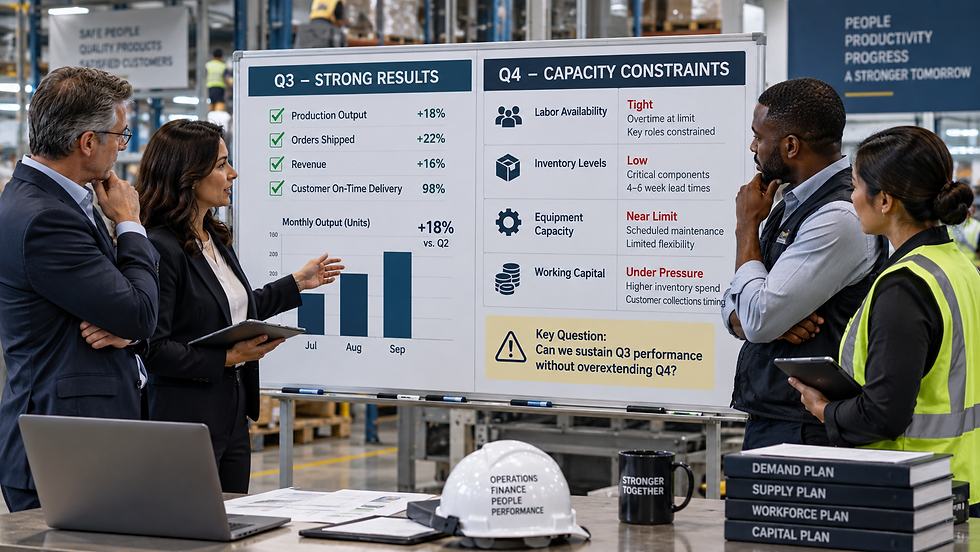
A late Q3 push has a specific shape. Sales pulls two deals forward. Operations adds a weekend shift to clear a backlog. A leadership team spends 3 weeks living inside the pipeline instead of the plan. The quarter closes above target, the board is pleased, and everyone moves straight into Q4 planning as if the number arrived on its own.
It did not. Revenue tells a company what happened. It rarely tells anyone what that result cost to produce, and that is the question worth asking before Q4 targets get locked. What did this quarter's win borrow from next quarter, and has anyone paid it back yet.
What a Strong Quarter Actually Borrows
A late-quarter surge draws on four resources at once, and each one has a repayment date that lands inside Q4.
Labor. Overtime, weekend coverage, and reassigned staff close a gap in September. That capacity does not reset on October 1. People who worked flat out for 3 weeks need recovery time, and the operations team that hit the number is often the same team expected to absorb Q4's regular volume plus whatever got deferred to make room for the push.
Inventory. A sales team that pulls orders forward draws down stock that was allocated to Q4 demand. The warehouse looks fine on September 30. The reorder cycle that should have started in August did not, because attention was on closing the quarter, not restocking for the one after it.
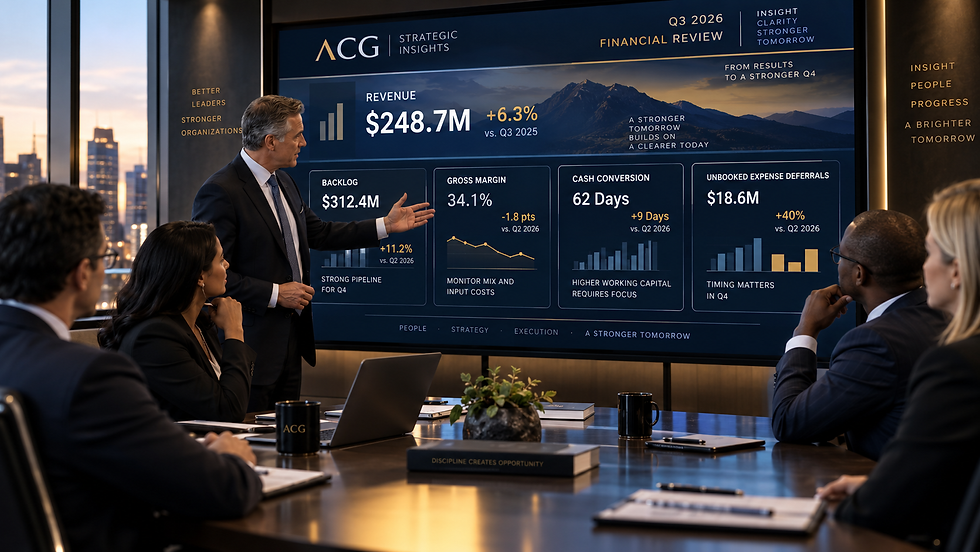
Cash. A pull-forward sale often means concessions. Extended terms, early-payment discounts, or expedited shipping costs all trade margin and cash timing for a bigger top-line number today. The receivable that results shows up as revenue in Q3 and as a collections problem in Q4.
Leadership attention. Every hour a leadership team spends managing a late-quarter push is an hour not spent on hiring decisions, vendor negotiations, or the strategic work that Q4 actually needs. That backlog does not disappear. It arrives in October, stacked on top of a fresh set of targets.
None of this is theoretical. Gartner's survey of 151 supply chain leaders, published as Gartner Survey Shows 72% of Supply Chain Leaders Revisit Final Approvals for Network Decisions at Least Once, Causing Delays, found that day-to-day instability, not just major disruptions, is what steadily drives up cost. Gartner ties that instability directly to premium freight, extra buffer stock, and overtime labor, the same three levers a late-quarter push leans on hardest. The finding did not need to be about quarter-end pressure specifically to make the point. Pulling operations out of their normal rhythm has a bill attached, whether the trigger is market turbulence or a self-imposed sprint to beat a number.
Aggregate Capacity Is Not Company Capacity
Industry-wide numbers can mislead here. The Federal Reserve reported in its September 18 Industrial Production and Capacity Utilization release that total U.S. industrial capacity utilization stood at 76.3% in August, 3.1 percentage points below its 1972 to 2025 average, with manufacturing lower still at 75.7%. Figures like these describe broad industrial headroom, not the constraint inside any specific business. A company can be running its own operation flat out at the exact moment its industry appears to have room to spare, which is why aggregate capacity and usable capacity are not the same number and a Q4 target built on the first while ignoring the second starts from the wrong baseline.
The Q4 Capacity Problem Hiding Inside a Good Quarter
The pattern that creates a Q4 capacity problem is almost always the same one that produced the Q3 win. Growth pulled forward from next quarter gets counted as this quarter's success and then forgotten, because success rarely gets audited the way shortfalls do. A missed number triggers a root-cause review. A beaten number triggers a celebration and a higher target.
That asymmetry is the actual risk. Teams that investigate misses closely and investigate wins barely at all will eventually build a plan on a false baseline. If the Q4 target for a given team assumes September's pace continues, and September's pace was borrowed rather than earned, the target is wrong before the quarter starts.
A late-quarter push rarely creates pressure everywhere at once. It moves the constraint. Sales closes a large order, so procurement accelerates materials. Procurement succeeds, but inventory absorbs more cash. Operations adds overtime and ships the product, but employees enter October already carrying extra hours. Eliyahu Goldratt, whose work on organizational bottlenecks shaped a generation of operations thinking, put a version of this problem plainly in Dr. Eli Goldratt Top 50 Quotes: "When quantities increase by an order of magnitude, it is not enough to increase capacity." His point extends past equipment. Higher volume can demand different supporting processes and controls, not simply more output squeezed from the same operation. The quarter gets saved. The constraint has merely changed addresses.
Inventory Can Make the Win Look Easier Than It Was
Inventory deserves particular attention because it can quietly finance a quarter-end surge. The U.S. Census Bureau reported in its September 16 Manufacturing and Trade Inventories and Sales release that business inventories reached $2.765 trillion in July 2026, up 0.8% from June, while combined sales rose a more modest 0.3%. The figures describe the broader economy, not any one company's shelves, but they underline the discipline every operations leader needs at quarter end: sales and inventory have to be read together, never separately.
Inside a company, the specific question is how much inventory got pulled forward to produce the Q3 result and when the cash tied up in it comes back. Taiichi Ohno, one of the architects of the Toyota Production System, described the underlying discipline in Toyota Production System: "the right parts needed in assembly reach the assembly line at the time they are needed." That is not simply about carrying less stock. It is about matching resources to actual flow rather than letting excess material paper over weaknesses underneath. A Q3 surge funded by unusually large purchases or inventory that will not turn until well into Q4 may still have been the right call. It should not, though, be mistaken for cost-free momentum.
Leadership Attention Belongs in the Capacity Model
Most capacity reviews account for people, equipment, inventory, and cash. One resource gets treated as unlimited when it is not: leadership attention. George Day and Roger Dennis, writing for Knowledge at Wharton in How Firms Can Overcome the 'Paradox of Preparedness', described the constraint directly: "The capacity of a leadership team to pay attention is like a sponge." Their research treats collective leadership attention as scarce, easily consumed by immediate operational demands, the same demands a late-quarter sprint generates in volume.
If the CEO, CFO, and operating executives spent September personally resolving exceptions, Q3 consumed leadership capacity along with everything else. A landmark Harvard Business Review study, When Growth Stalls, found that among companies that hit an abrupt growth stall, a talent bench shortfall at the executive level was one of the most common internal causes, more common than external shocks like a downturn. Executives who spend a quarter firefighting are executives who are not building the bench, the process, or the strategic clarity Q4 needs from them.
Four Questions Before Locking Q4 Targets
Leaders can check whether a Q3 win is borrowing from Q4 with four direct questions, run before targets get finalized rather than after a miss forces the reckoning.
Q3 to Q4 capacity audit:
Labor. What overtime, deferred leave, or reassigned staff produced the Q3 result, and is any of it still owed to people in October?
Cash. When did money go out to fund the push, and when do the related receivables actually arrive?
Inventory. How much safety stock or Q4-allocated material got consumed early, and what is the honest replenishment timeline?
Leadership. How many hours did the leadership team spend managing the push, and what strategic work got delayed because of it?
A team that can answer all four with confidence has a genuine, repeatable improvement. A team that cannot has a capacity problem wearing a win's clothing, and the diagnostic works best as a joint review across sales, operations, and finance rather than three separate reports filed after the fact.
Setting Q4 Targets on the Real Baseline
The fix is not to discount every strong quarter as suspect. Some wins are structural. New capacity came online, a process improvement removed a bottleneck, or a market shifted in the company's favor. Those gains compound and belong in next quarter's plan at full value.
The fix is to separate the two before committing to a number. One practical approach: build the Q4 forecast in two layers. The first layer is the sustainable run rate, calculated from a normal week rather than the final push of Q3. The second layer is a specific list of what got pulled forward or deferred, with a plan for when it gets repaid. A target built on the first layer alone is conservative and durable. A target that quietly assumes the second layer repeats itself is the one that produces a rough October.
This same audit works across markets and fiscal calendars, not only for companies running a calendar-year quarter. A manufacturer in Germany pulling shipments forward ahead of a March fiscal close and a services firm in Singapore closing seats ahead of a calendar quarter are running the same play, and they will pay the same price for it in the following period if nobody checks the source of the number.
Capacity planning done well treats last quarter's number as a data point to interrogate, not a floor to build on automatically. The leaders who ask where a win came from before setting next quarter's target are the ones who avoid discovering the answer the hard way, in the middle of Q4, when the bill comes due.
Planning Q4 Capacity Before the Targets Get Set
Aspirations Consulting Group works with executive teams on operations and financial strategy, including capacity modeling and working capital planning, at the point where a strong quarter needs to be separated from a sustainable one before next quarter's targets get locked. ACG's advisory team works directly with leadership on exactly this kind of diagnostic.
Catch the Next Capacity Problem Early
Readers who want more analysis like this can get a complimentary subscription to ACG Strategic Insights, delivered daily to more than 10 million executives and aspiring leaders worldwide.
Thanks for reading!
~ Jerry Justice
Living to Serve, Serving to Lead™


Comments